
Honeywell Air Conditioner Thermostat Manual: A Comprehensive Guide
Honeywell offers diverse, high-tech solutions, including the RTH9580WF Smart Wi-Fi thermostat. These models, while functional, sometimes lack the aesthetic appeal of competitors.
Understanding Honeywell Thermostats
Honeywell thermostats represent a significant presence in home climate control, offering a wide array of models from basic programmable units to advanced smart Wi-Fi enabled systems like the RTH9580WF. These thermostats are designed to manage heating and cooling systems efficiently, contributing to both comfort and energy savings.
The company’s product line extends beyond simple temperature regulation, encompassing air purifiers with multi-layered filtration systems – some boasting five layers – and even specialized solutions like pre-filters for water purification. While primarily known for HVAC control, Honeywell’s diversification demonstrates a commitment to improving indoor environmental quality.
Understanding the core functionality of a Honeywell thermostat involves recognizing its ability to schedule temperature changes, respond to user input, and, in the case of smart models, connect to home networks for remote control via applications like the Honeywell Home app. The brand’s reputation is built on reliability and a broad range of features catering to diverse homeowner needs.
Thermostat Model Identification
Honeywell produces a diverse range of thermostats, making accurate model identification crucial for accessing the correct manual and support resources. Key models include the RTH9580WF Smart Wi-Fi thermostat, noted for its programmability, and various air purifier models like the KJ1000F-P22W, designed for large spaces and featuring multi-stage filtration.

Beyond thermostats, Honeywell’s portfolio extends to lighting solutions, such as the 02LFPro, and even automotive accessories like car chargers. However, focusing on HVAC, identifying your specific thermostat often involves locating a label on the device itself, typically on the back or inside the battery compartment.
This label will display the model number, which is essential for downloading the appropriate user manual or contacting Honeywell support. Knowing the model also helps determine compatibility with smart home systems and available features. Correct identification ensures you can fully utilize your thermostat’s capabilities.

RTH9580WF Smart Wi-Fi Thermostat Overview
The Honeywell RTH9580WF Smart Wi-Fi Thermostat is a programmable model offering convenient control over your home’s heating and cooling systems. While praised for its functionality, some users note its plastic construction doesn’t match the premium aesthetic of competitors like Nest, which feature stainless steel and glass designs.
This thermostat allows for remote control via the Honeywell Home app, enabling adjustments from anywhere with an internet connection. It supports scheduling, temporary and permanent holds, and potentially integrates with other smart home devices. The RTH9580WF aims to provide energy savings and comfort through personalized climate control.
Beyond HVAC, Honeywell’s product line includes air purifiers like the KJ455F-TAC2022WS, boasting a five-layer filtration system, and various accessories. However, the RTH9580WF specifically focuses on delivering a smart and efficient thermostat experience.
Basic Thermostat Operation
Understanding the fundamental operation of your Honeywell thermostat is crucial for comfortable and efficient climate control. Initial setup involves powering on the device and navigating the interface to establish basic settings. The thermostat’s primary function is to regulate temperature by controlling your heating and cooling systems.
Users can typically adjust the setpoint temperature directly on the thermostat’s display. Many models offer modes like “Heat,” “Cool,” “Auto,” and “Off,” allowing you to select the desired operation. The display will show the current room temperature and the target temperature.
Furthermore, Honeywell’s broader range includes air quality solutions like the KJ1000F-P22W purifier, but the core operation of the thermostat remains focused on temperature regulation. Familiarizing yourself with these basic functions is the first step towards maximizing your thermostat’s benefits.
Powering On and Initial Setup
Upon installation, powering on your Honeywell thermostat initiates the initial setup process. Ensure the thermostat receives adequate power, typically through a C-wire connection or batteries, depending on the model. The display should illuminate, prompting you to begin configuration.
The first step usually involves selecting your preferred language and setting the date and time. Accurate timekeeping is essential for scheduling features. The thermostat may then guide you through connecting to your home’s Wi-Fi network, enabling smart features and remote control via the Honeywell Home app.
During setup, you might be asked to identify your system type (e.g., forced air, heat pump). Correctly identifying your system ensures optimal performance. Remember, Honeywell also offers air purifiers like the KJ455F-TAC2022WS, but initial thermostat setup focuses solely on climate control functionality.

Display and Interface Explanation
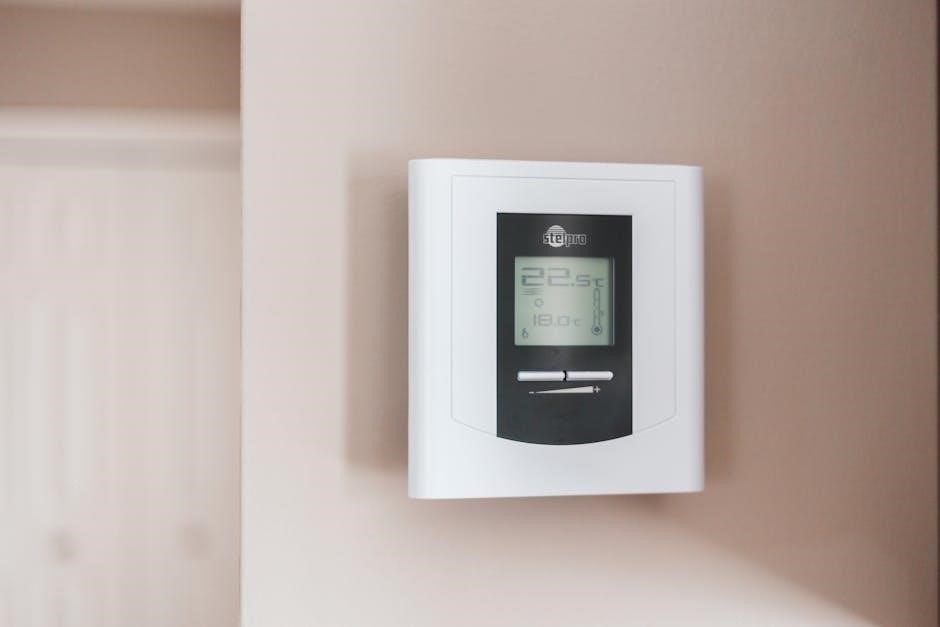
The Honeywell thermostat display provides crucial information at a glance. Typically, you’ll see the current room temperature, set temperature, operating mode (heat, cool, auto, off), and time. Icons indicate active features like Wi-Fi connectivity or fan operation.
The interface often utilizes a combination of touchscreen controls and physical buttons. Touchscreens allow for intuitive navigation through menus and settings. Buttons provide quick access to frequently used functions, such as temperature adjustment or mode selection. The RTH9580WF model, for example, features a clear, backlit display.
Navigating the menus allows access to scheduling, advanced settings, and system information. Understanding the icons and terminology is key to effective operation. While Honeywell also produces air quality solutions like the KJ1000F-P22W, the thermostat display focuses on temperature and climate control.
Programming Your Honeywell Thermostat
Honeywell thermostats offer flexible programming options to optimize comfort and energy savings. Creating a schedule allows you to set different temperatures for various times of the day and days of the week. This ensures your home is comfortable when occupied and conserves energy when empty.
Most models support multiple program periods per day, enabling customized temperature settings for wake, leave, return, and sleep times. The RTH9580WF Smart Wi-Fi thermostat simplifies this process with its intuitive interface and remote access via the Honeywell Home app.
Programming involves setting the desired temperature for each period and assigning it to specific days. Temporary and permanent holds override the programmed schedule, providing immediate temperature adjustments. Remember to review and adjust your schedule seasonally to maximize efficiency, much like maintaining filters in air purifiers like the KJ455F-TAC2022WS.
Setting the Date and Time
Accurate date and time settings are crucial for proper thermostat operation, especially when utilizing scheduling and smart features. Incorrect time settings can lead to programs running at unintended times, impacting comfort and energy efficiency. The initial setup process typically prompts you to configure these settings.
Access the date and time settings through the thermostat’s menu, usually navigated using the up and down arrow buttons. The Honeywell Home app, when connected, also allows remote adjustment of these parameters. Ensure your thermostat is synchronized with your local time zone for optimal performance.
Refer to your specific model’s manual for detailed instructions, as the menu structure may vary. Just as maintaining a clean filter (like those in the Honeywell KJ1000F-P22W) is vital for air quality, accurate timekeeping is vital for thermostat functionality. Double-check the settings after power outages or initial installation.
Creating a Schedule
Programming a schedule allows your Honeywell thermostat to automatically adjust temperatures based on your daily routine, maximizing comfort and minimizing energy consumption. Most Honeywell models, like the RTH9580WF, support multiple daily periods, enabling customized settings for wake, leave, return, and sleep times.
Access the scheduling function through the thermostat’s menu. You’ll typically define a different temperature for each period of the day. Consider your lifestyle – for example, lowering the temperature while away, similar to the filtration system in the Honeywell KJ455F-TAC2022WS working efficiently when unoccupied.
The Honeywell Home app provides a user-friendly interface for creating and modifying schedules remotely. Experiment with different settings to find the optimal balance between comfort and energy savings. Remember to save your changes after each adjustment. Regularly review and update your schedule to reflect seasonal changes or alterations in your daily routine.
Temporary and Permanent Holds
Honeywell thermostats offer “Hold” features to override programmed schedules. A Temporary Hold maintains a selected temperature for a specified duration, after which the thermostat reverts to the scheduled program. This is ideal for short-term deviations from your routine, like an unexpected evening at home.
A Permanent Hold, conversely, sets a constant temperature indefinitely, disregarding the programmed schedule entirely. Use this when a long-term change occurs, such as an extended vacation or a shift in work hours. Remember, activating a Permanent Hold requires manual intervention to resume scheduled programming.
Accessing the Hold function is usually straightforward via the thermostat’s interface or the Honeywell Home app. Be mindful of energy consumption when using Holds, especially Permanent Holds. Similar to the efficient filtration in models like the KJ1000F-P22W, thoughtful use of features optimizes performance. Always confirm the Hold status displayed on the thermostat to avoid unintended temperature settings.
Wi-Fi Connectivity and Smart Features
Honeywell’s RTH9580WF thermostat distinguishes itself with integrated Wi-Fi capabilities, enabling remote control and advanced smart features. Connecting to your home network unlocks access to the Honeywell Home app, allowing temperature adjustments from anywhere with an internet connection. This is particularly useful for managing energy consumption during travel or unexpected schedule changes.
Smart features extend beyond remote control. The app provides detailed energy usage reports, helping you identify potential savings. Geofencing capabilities automatically adjust the temperature based on your location, optimizing comfort and efficiency. Like the advanced filtration in Honeywell air purifiers (e.g., KJ455F-TAC2022WS), these features enhance overall system performance.
Ensure a stable Wi-Fi connection for optimal functionality. The Honeywell Home app is compatible with various smart home platforms, offering seamless integration with other devices. Regular software updates, delivered via Wi-Fi, keep your thermostat secure and up-to-date with the latest features.
Connecting to Your Home Network
Establishing a Wi-Fi connection is crucial for utilizing the smart features of your Honeywell thermostat. Begin by ensuring your home network is active and you have the network name (SSID) and password readily available. On the thermostat’s display, navigate to the network settings menu – typically found within the settings or connectivity options.
The thermostat will scan for available networks. Select your network from the list and enter the password using the on-screen keyboard. A successful connection will be indicated by a Wi-Fi symbol on the display. If the connection fails, double-check the password and ensure the thermostat is within range of your router.
Troubleshooting may involve restarting both the thermostat and your router. Similar to resolving issues with Honeywell air purifiers, a power cycle can often resolve connectivity problems. Refer to the Honeywell Home app for additional support and detailed instructions specific to your thermostat model. A stable connection unlocks remote control and updates.
Remote Control via Honeywell Home App
Once your Honeywell thermostat is connected to your home Wi-Fi network, you can unlock its full potential through the Honeywell Home app. Download the app from your device’s app store (iOS or Android) and create an account or log in if you already have one.
The app allows you to remotely control your thermostat from anywhere with an internet connection. You can adjust the temperature, create and modify schedules, and monitor energy usage. The app mirrors the thermostat’s interface, providing a user-friendly experience.
Similar to managing Honeywell air purifiers remotely, the app offers convenient control. Features include geofencing, which automatically adjusts the temperature based on your location, and smart alerts that notify you of unusual activity. Regular app updates ensure optimal performance and access to new features, enhancing your comfort and energy savings.

Troubleshooting Common Issues
If your Honeywell thermostat isn’t responding, first check the power supply and ensure it’s receiving adequate voltage. For incorrect temperature readings, consider recalibrating the thermostat through the settings menu. Wi-Fi connection problems can often be resolved by restarting your router and re-connecting the thermostat to your network.
Should issues persist, a complete power cycle – disconnecting the thermostat from its power source for a period – can sometimes reset the system. If the device continues to display errors, particularly sensor-related faults, professional assistance may be required.
Remember to consult Honeywell’s support resources or contact their customer service for more complex problems. Regularly checking and replacing the air filter (discussed later) can also prevent many operational issues. Don’t hesitate to seek expert help if self-troubleshooting fails.
Thermostat Not Responding
When your Honeywell thermostat fails to respond, begin by verifying the power supply. Ensure the unit is receiving adequate voltage; check the circuit breaker and wiring connections. A simple reset can often resolve minor glitches – try briefly disconnecting the power source, waiting a few moments, and then reconnecting it.
If the display remains blank, inspect the batteries (if applicable) and replace them with fresh ones. Confirm that the thermostat is securely mounted and that no wires are loose or damaged. A complete power cycle, involving a longer disconnection period, might be necessary to fully reset the system.
If these steps don’t restore functionality, consult the manual for specific troubleshooting guidance or contact Honeywell’s customer support for assistance. Sensor malfunctions could also be the cause, requiring professional diagnosis.
Incorrect Temperature Readings
If your Honeywell thermostat displays inaccurate temperature readings, several factors could be at play. First, ensure the thermostat isn’t directly exposed to sunlight, drafts, or heat-generating appliances, as these can skew the sensor’s measurements. Check for obstructions blocking airflow around the unit; dust accumulation can also contribute to inaccurate readings.
Honeywell thermostats offer temperature calibration features. Consult your model’s manual to learn how to adjust the temperature offset, allowing you to fine-tune the displayed temperature to match a trusted external thermometer. A malfunctioning sensor is another possibility, particularly if calibration doesn’t resolve the issue.
Consider a complete power cycle – disconnecting power for a period – as a potential reset. If problems persist, contacting Honeywell support or a qualified HVAC technician is recommended for diagnosis and potential sensor replacement.
Wi-Fi Connection Problems
Experiencing Wi-Fi connectivity issues with your Honeywell thermostat? Begin by verifying your home network is functioning correctly with other devices. Ensure the thermostat is within range of your router; walls and distance can weaken the signal. Double-check you’ve entered the correct Wi-Fi password during setup – case sensitivity matters!
A simple reboot of both your router and the thermostat can often resolve temporary glitches. If the problem persists, consult the Honeywell Home app for troubleshooting steps specific to your model. Interference from other wireless devices can also be a culprit; try changing your router’s channel.
If all else fails, consider resetting the thermostat’s Wi-Fi settings to factory defaults and re-establishing the connection. Contacting Honeywell support may be necessary for more complex network configurations or potential firmware issues.
Filter Replacement and Maintenance
Regular maintenance is crucial for optimal performance of your Honeywell air conditioner system, and a key component is the air filter. Honeywell air purifiers, like the KJ455F-TAC2022WS, boast 5-layer filtration systems, emphasizing the importance of clean filters. Locate your air filter – typically behind a removable panel on the unit itself.
The filter type will vary depending on your model; consult your manual for specifics. Generally, filters should be replaced every 1-3 months, or more frequently if you have pets or allergies. A clogged filter restricts airflow, reducing efficiency and potentially damaging the system.
Cleaning the thermostat itself requires only a soft, dry cloth. Avoid using liquids or abrasive cleaners. Regularly inspect the filter for dirt and debris, and replace it promptly when needed to maintain air quality and system longevity.
Air Filter Location and Type
Locating the air filter within your Honeywell air conditioning system is the first step towards proper maintenance. Typically, the filter is situated behind an easily accessible panel on the unit itself, often near the blower compartment. Refer to your specific model’s manual for precise instructions, as locations can vary.
Honeywell utilizes various filter types depending on the model. Some, like those in the KJ455F-TAC2022WS, feature multi-layer systems designed for enhanced filtration. Common types include disposable fiberglass filters, pleated filters, and washable electrostatic filters. The manual will clearly state the recommended filter type for your unit.
Ensure you select the correct size and type to guarantee optimal performance. Using an incorrect filter can reduce airflow and compromise the system’s efficiency. Regularly checking and replacing the filter is vital for maintaining air quality and extending the lifespan of your Honeywell system.
Cleaning the Thermostat
Maintaining a clean thermostat ensures accurate readings and optimal performance of your Honeywell system. Before cleaning, always power off the thermostat to prevent electrical shock or damage. Gently remove the thermostat cover – consult your model’s manual for specific instructions, as methods vary.
Use a soft, dry cloth to wipe down the exterior of the thermostat and the display screen. Avoid using liquids, abrasive cleaners, or excessive moisture, as these can damage the sensitive electronic components. For stubborn dirt, lightly dampen the cloth with water, ensuring it’s almost dry before wiping.

Pay attention to the vents, carefully removing any dust buildup with a soft brush or canned air. Once cleaned, reattach the cover securely and restore power. Regular cleaning, every few months, will help keep your Honeywell thermostat functioning reliably and accurately for years to come.
Advanced Settings and Customization
Honeywell thermostats offer a range of advanced settings to tailor your comfort and energy savings. Fan Control Options allow you to select ‘Auto’ for operation only during heating or cooling, or ‘On’ for continuous air circulation. Explore settings for cycle rate, adjusting how frequently the system turns on and off, impacting comfort and efficiency.
Temperature Calibration is crucial if you notice discrepancies between the thermostat reading and a trusted thermometer. Adjust the calibration in small increments to ensure accuracy. Some models feature swing/differential settings, controlling the temperature range before the system activates.
Delve into filter change reminders, customizing alerts based on usage. Advanced users can explore system test functions for diagnostics. Remember to consult your specific model’s manual for detailed instructions and available options, maximizing your Honeywell thermostat’s potential.
Fan Control Options
Honeywell thermostats provide versatile Fan Control Options, significantly impacting air circulation and comfort. The ‘Auto’ setting operates the fan only during heating or cooling cycles, conserving energy and minimizing noise. Conversely, selecting ‘On’ keeps the fan running continuously, promoting even temperature distribution and enhanced air filtration.
Continuous fan operation can be beneficial for allergy sufferers, constantly circulating air through the filter. However, it increases energy consumption. Some advanced models offer a ‘Circulate’ mode, running the fan intermittently to maintain consistent temperatures without constant operation.
Explore settings related to fan speed if your system supports it. Adjusting fan speed can optimize airflow and noise levels. Refer to your specific model’s manual for detailed instructions on accessing and configuring these fan control features, tailoring them to your preferences and needs.

Temperature Calibration
Temperature Calibration is a crucial feature for ensuring accurate readings on your Honeywell thermostat. Discrepancies between the thermostat’s display and a trusted thermometer indicate a need for calibration. Accessing this function typically involves navigating through the thermostat’s settings menu – consult your specific model’s manual for precise steps.
Calibration allows you to adjust the displayed temperature up or down in small increments (e.g., 1 or 2 degrees Fahrenheit). Compare the thermostat reading with a calibrated thermometer placed nearby. Adjust the calibration setting until the thermostat accurately reflects the thermometer’s reading.
Proper calibration optimizes heating and cooling efficiency, preventing the system from running unnecessarily. If calibration doesn’t resolve significant discrepancies, consider a sensor issue or contact Honeywell support for assistance. Regular calibration maintains comfort and energy savings.
Honeywell Support and Resources
Honeywell provides extensive support for its thermostat products, ensuring customers can resolve issues and maximize their system’s performance. For immediate assistance, the Honeywell Home website (honeywellhome.com) offers a comprehensive FAQ section, troubleshooting guides, and downloadable manuals for various models, including the RTH9580WF.
Customers can also access Honeywell’s customer support team via phone. The official website lists contact numbers for different regions and product lines. Online chat support is often available for quick answers to common questions. Additionally, Honeywell’s online community forums allow users to share experiences and solutions.
For complex issues or sensor malfunctions, professional assistance may be required. Honeywell’s website provides a directory of authorized service providers. Remember to have your thermostat’s model number readily available when contacting support for efficient assistance.